
Northeast religious spaces: diversity in cultures and architecture
September 23, 2017
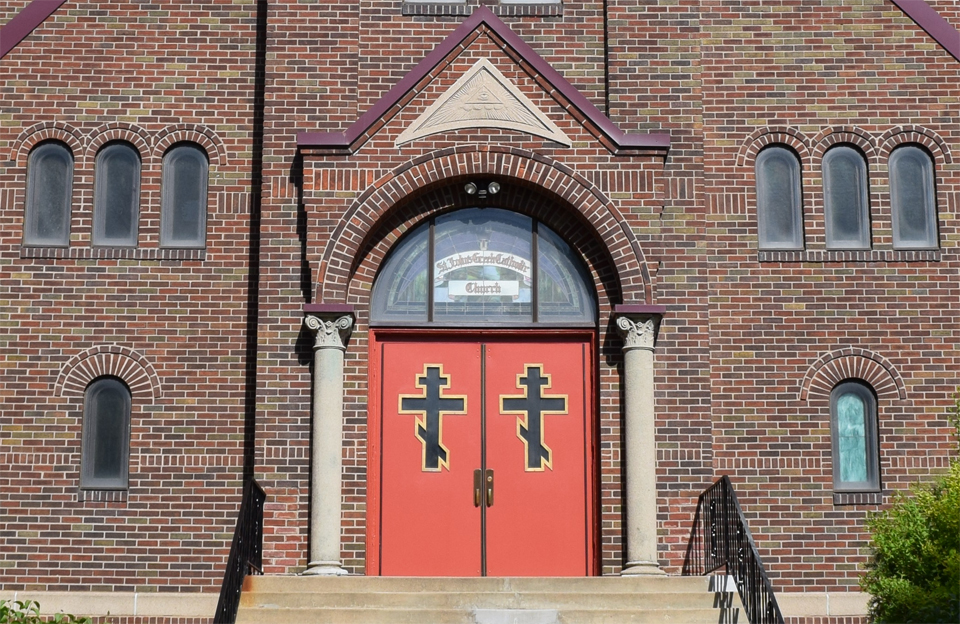


For more than a century, locals have known Northeast Minneapolis for its lively mix of cultures. A trip along Central Avenue reveals many tempting restaurants that represent cuisines from around the world. Beyond the wonders of Central Avenue, old standbys such as Kramarczuk’s Sausage Company, Emily’s Lebanese Deli, and Sikora’s Polish Market dot the area, and you can buy pyrohy/perohi on carefully timed trips to St. Constantine’s Ukrainian Catholic Church or St. Mary’s Russian Orthodox Cathedral.
Ethnic food sales from church kitchens make perfect sense in Nordeast, where connections between immigrant communities and their religious spaces have remained strong over the past century. In the midst of the broader American society, faith communities were—and often remain—home to the expression of immigrant traditions, foodways, and languages. On any given weekend in Northeast Minneapolis, it is possible to find religious services in Spanish, Aramaic, Polish, French, Arabic, Ukrainian, and Slavonic languages.
Along with its great variety of ethnic origins (including the “Yankees”), churches in Nordeast also include many denominational traditions. The city’s development and spread from the settlements near the river toward new neighborhoods in the north and east fueled waves of church construction. The same may be said for many congregational splits based on growth or politics. The result is an area filled with sacred spaces, some of which date to the origins of Minneapolis. A surprising amount mobility and fluidity in building owners and locations fills the history of Nordeast religious buildings. Our tour route takes us past a Presbyterian church that’s now a Tibetan monastery, as well as another that is home to a Bosnian mosque. We will also learn about buildings that were moved from site to site, serving different groups at various stages of their development.
Our tour will begin at St. Anthony of Padua, one of the first parishes established in the area. After a brief presentation on the background of Northeast Minneapolis religious spaces, we will make our way—by bus and on foot—around four clusters of buildings. They represent Nordeast’s denominational and ethnic groups, and they include various styles of architecture popular in religious building in the nineteenth and twentieth centuries. We will also see buildings designed by a number of important Twin Cities architects who worked in Nordeast, including Victor Cordella, Harry Wild Jones, Omeyer and Thori, Augustus Gauger, Charles Hausler, Bard and Vanderbilt, and Hills, Gilbertson and Hays. When the tour ends, you’ll be perfectly positioned to choose any number of wonderful spots for lunch.
Our tour guide is Kristin Anderson, who started visiting Nordeast churches many years ago while working on an MA in Church History at Luther Seminary, where her research focused on Norwegian-American immigrant church art. These days, Kristin studies a different kind of religious space: local sports facilities. She enjoys giving tours at Target Field and around the Twin Cities, especially for the Preservation Alliance of Minnesota. Kristin’s long career teaching art history and architectural history at Augsburg College ended in the spring. This fall, she will resume her work at Augsburg University.
Date and Place
Saturday, September 23, 2017, 9:00 a.m. – 12:30 p.m.
We meet at St. Anthony of Padua Church, 813 NE Main Street, Minneapolis, and the tour begins with a brief presentation inside the church.
This is a bus tour with some walking segments. It’s rain or shine: be sure to dress appropriately, have the right rain/sun gear for the day, and wear comfortable shoes.
Cost
$30 for current MNSAH members
$40 for nonmembers
Join or renew your membership
Registration
This event has passed.


